2 Jun 2026 / Essay
Rare on purpose.
Most content operations share the same premise: the constraint is budget or bandwidth. If there were more money, there would be more posts. If there were more people, there would be more formats, more channels, more distribution endpoints. The question that organizes the whole operation is how do we publish more?, and the answer is always some version of the same thing: hire, automate, or find a cheaper way to produce.
This is the default. Not because it works, but because it is legible. More output is easy to measure. A content calendar filled with posts looks like progress. A dashboard full of impressions and reach numbers looks like a team doing its job. These are the numbers Eric Ries called vanity metrics: they climb with effort and flatter the quarter without proving the work was good. Growth is read off the output rate. Slow weeks look bad regardless of quality. The analytics do not distinguish between a week that was quiet because the team was writing something excellent and a week that was quiet because nothing got done. The incentive structure points one direction: more.
The constraint is always budget and bandwidth. The constraint is never the choice to produce less.
Volume is the strategy, and the strategy is rarely questioned. Not because the evidence compels it, but because questioning it requires choosing something harder to measure. Something that does not show up on the weekly dashboard. Something that requires patience before it pays off. The volume strategy is easy to justify in a meeting. A scarcity strategy is harder to defend until it has already worked.
Impression-led content optimizes for what is cheap to count, not what is hard to earn.
When the organizing question is how do we publish more?, the selection pressure on the work changes. Speed gets rewarded over depth. Topics that move fast through a distribution algorithm get commissioned over topics that demand a reader's full attention. Length gets compressed toward what a social platform prefers. Anything that takes more than two minutes to skim gets shortened. Anything that does not hit the dashboard within forty-eight hours gets deprioritized.
The output of that selection process is a channel that delivers volume metrics: impressions, reach, open rates, shares. And a reader who has learned, not consciously but reliably, that the work is cheap to receive. Because it is. It was built to be cheap to receive. The optimization ran in that direction.
Volume metrics select for content that is forgettable on purpose. The loop runs cleanly. The channel fills up. The reader scrolls. The signal-to-noise ratio drops, and the response to a dropping signal-to-noise ratio, under the volume strategy, is to add more signal, which is to say more output, which is to say more noise.
The loop is self-reinforcing. Most channels stay in it.
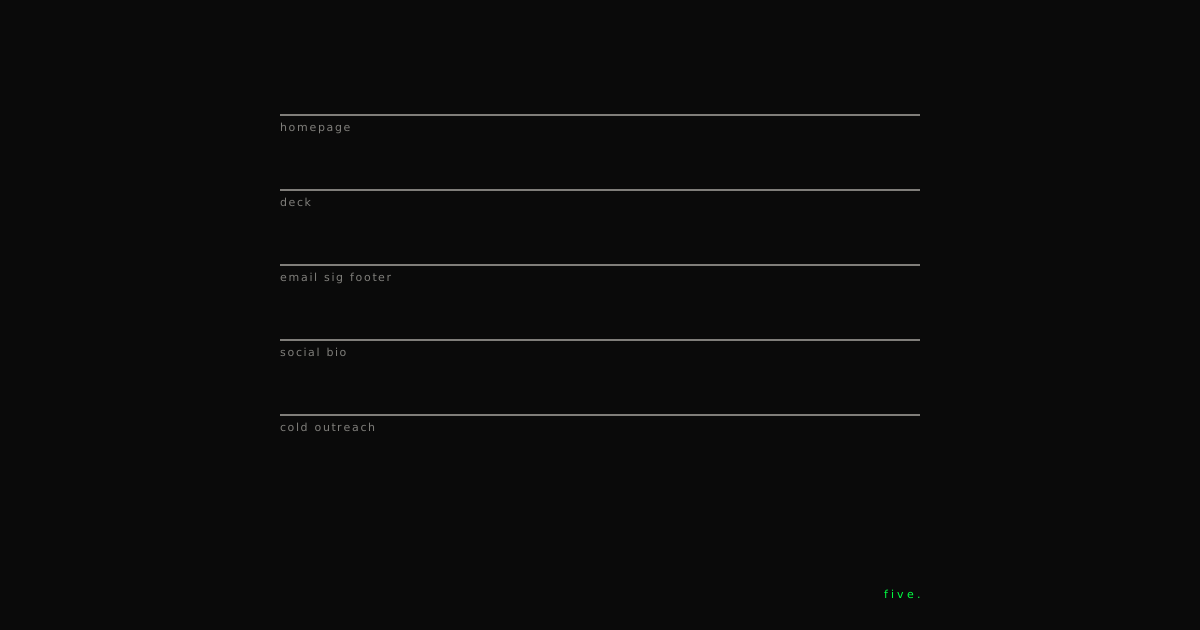
Pagecut has a hero line (seven words, the thesis compressed), and it lives in five places only: the homepage hero, the deck cover, the email signature footer, the social bio, the cold outreach opener. That is the list. The list is not subject to revision by convenience.
Not because the words are fragile. Because rarity is the strategy.
A line that appears everywhere becomes wallpaper. The reader's eye learns to skip it, the way the eye skips any pattern that repeats often enough. That learned filtering is what Nielsen Norman Group's eyetracking research calls banner blindness. The constraint is not that the line cannot survive more surface area. The constraint is that its signal value depends on not being there. The restriction is designed in.
This is not a stylistic preference. It is a structural decision about how signal works. The hero line earns its weight by being rare. The moment it migrates to section headers, to tweet threads, to every paragraph that needs a lift, it joins the volume. It becomes exactly what it is claiming not to be.
One line, five surfaces. The rule is the discipline. Every time the line does not appear somewhere it could have appeared, it remains effective where it does.
The publication cadence is one long-form editorial essay every Tuesday. Length 1,800 to 3,500 words. A single canonical version, published first on Pagecut, before any syndication. Not one per week when the team has capacity. Not compressed to a shorter format when a week runs short. One. Every Tuesday.
We publish on a fixed cadence. Format is iterable. Cadence is not.
The format is subject to iteration — length, structure, the number of sections, whether a piece opens with a claim or a scene. Those are variables the editorial judgment works with. The cadence is not a variable. The cadence is a commitment with a specific operating implication: a reader who knows Pagecut publishes every Tuesday is a reader who has made a slot for it. A reader who encounters Pagecut on an irregular schedule, sometimes there, sometimes not, whenever the team gets to it, has no slot to make. The rhythm is not the container for the work. The rhythm is part of the work.
Publishing every Tuesday means the week is organized around the essay, not the essay around a gap in the calendar. The constraint is not that the team can only manage one essay per week. The constraint is that one essay per week is what the thesis demands: one piece with a real shot at being worth finishing. The discipline of doing that every week, without variation in the cadence, is what builds reader trust in the rhythm. That trust is not built with volume. It is built with consistency, and consistency requires the cadence to be non-negotiable.
Scarcity of publish moments makes each one consequential. When every Tuesday carries weight, no Tuesday is filler. That is a design property, not an accident of limited capacity. The cap is chosen, not imposed.
Pagecut publishes only what passes a written craft bar.
That sentence sounds like a quality-control step at the end of the pipeline, a review where someone checks if the output is good enough before it goes out. It is not that.
The craft bar is a gate, not a target. It operates upstream. It shapes what gets commissioned, what gets drafted, what gets edited, what gets submitted for the final review. If a piece cannot clear the gate, it does not exist on the editorial calendar. The gate does not operate on hope that the draft will get there. It operates on a predicate that filters before the draft starts.
The bar has sections: editorial craft, visual output, internal production pipeline stages with explicit roles and timing. Each section has predicates. The predicates are written down and they are applied per publish event. The production log is the auditable record. A publish either clears all sections or it does not happen.
This gate-not-target distinction matters because a target is aspirational. You can publish below a target and note the gap for next time. A gate is structural. There is no publish-below-the-gate with a plan to improve. The gate and the absence of publish are the same event.
What this produces is not higher average quality. It produces a different kind of selection. When every publish must clear the gate, the volume drops to what the gate admits. The gate is set high enough that clearing it requires the full production sequence. The sequence is the scarcity mechanism at the craft layer.
Pagecut keeps its surfaces and its rhythm rare on purpose. Scarcity is the discipline; signal-to-noise is the result.
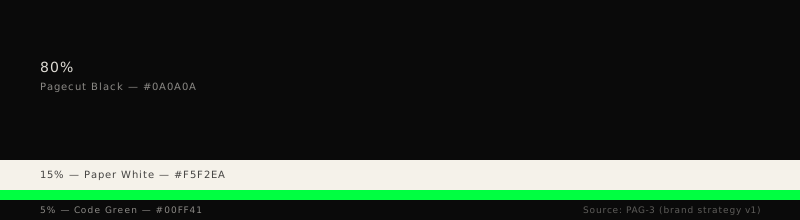
The visual palette is nearly monochrome: 80% Pagecut Black, 15% Paper White, 5% Code Green. One accent color, once per surface, at a maximum. Not because this is the only palette that could work. Because a palette with more variation is a palette in which less is load-bearing. The 5% color works because it is rare. At 20%, the same color becomes decoration.
The motion budget is minimal. The hero animation resolves quickly. Everywhere else: restraint. Not because motion is bad, but because motion that does not carry argument is motion that trains the eye to skip, that trains the reader to recognize, before reading, that something in the frame is not asking for attention. Reduce the motion to what earns attention, and the motion that remains earns it.
Typography is a collision: editorial serif for display, monospace for labels. That collision is not ornamental. When both typefaces are doing their job, the collision carries an argument about what kind of operation Pagecut is: the rigor of the editorial discipline and the precision of the technical one, sharing a surface without collapsing into each other. Remove the collision and you remove the argument.
When scarcity is the design, every surface is load-bearing. Every pixel, every word, every publish moment carries weight because the decision to include it was made against the alternative of leaving it out. Nothing is present to fill space. Nothing is there because it was easy to add.
The result is a surface where signal-to-noise is high not because the signal is louder, but because the noise was designed out.
Volume is a vanity metric. Finish-rate is a fitness metric.
The publishing industry has organized itself around the vanity metric, around impressions, reach, output rate, because those are the signals a content calendar generates. They are also the signals a reader does not pay anything real to produce. An impression costs the reader nothing, and Google sells advertisers a thousand of them at a time. A scroll costs zero. A share takes a second. These signals are cheap because the content that produces them was designed to be cheap.
Finishing a piece costs something. Reader time, reader attention, reader trust that the piece will be worth completing. That investment is not made on cheap content. It is made on work that has earned the expectation of being worth it — work where the rhythm of publication signals investment, the craft gate signals selection, the surface design signals nothing is accidental.
Pagecut work earns finishes, not scrolls.
The way to earn a finish is to make each piece worth finishing. The way to make each piece worth finishing is to put the whole operation in service of that goal, to design the surfaces so they signal investment rather than volume, to guard the cadence so the rhythm is legible, to run the craft gate so nothing enters the cadence that cannot clear it.
That is scarcity as a positive program. Not a limitation on what could be published. A commitment to the conditions under which signal is actually produced. Each surface load-bearing. Each publish consequential. Each reader who finishes having invested something real, because the work asked for it, and delivered on the ask.
The discipline that produces that is not minimalism. It is not resource constraint. It is a set of deliberate design decisions made against the default, held consistently, and compounded over time.
Rare on purpose.